




Local Resident
Proud
Members Of




Even under ideal conditions, surgery is a stressful procedure. When you decide to have surgery to repair a torn muscle or tendon, you agree to put your body in the hands of another person to fix what’s wrong, and you also agree that the procedure will make you weaker before it makes you stronger.
You should never let surgery unfold to you; instead, you should recognize it for what it is and do everything you can to make it as efficient as feasible in making you feel healthier.
Before anything else, let’s understand what these terms mean.
To optimize the result of your operation, your surgeon should propose pre-surgical therapy. According to statistics, starting physiotherapy a month or so before a surgical procedure can significantly reduce the recovery time.
Planning for surgery can be stressful, but a pre-therapy regimen could be beneficial to help you relax. Pre-therapy treatment regimens give you whatever you require to be as technically and emotionally ready for your operation as feasible.
The following are some benefits you can reap from undergoing pre-rehab therapy:

Pre-therapy can help you recover from surgery with less pain. Dry needling, water treatment, workout, and manual therapy are some of the modalities that can be used to achieve this.


Pre-therapy makes the surgical procedure go more smoothly. Before surgery, possessing powerful and developed muscles makes it a lot easier and faster to return to your regular schedule.

Pre-therapy, according to the American Physical Therapy Association (APTA), can substantially boost surgical results and potentially save money if everything goes well. If you develop your muscles before surgery, your surgery will be a more fruitful and quicker healing process.

Tailored activities are included in pre-therapy to assist you in improving your stamina and tolerance. As a consequence, your immunity may be enhanced, lowering your risk of infection following surgery.

Any surgical operation will cause a loss of energy as your body recovers. Pre-therapy, on the other hand, can contribute to a reduction of the strength lost by improving your stamina before the procedure. As a result, the healing process will be significantly easier because less energy will be lost.

Pre-Surgery therapy can often completely prevent the necessity for surgery. Though this isn’t always the case, certain patients have discovered that their pre-hab procedures effectively avoided their surgery.
You may be able to avoid invasive procedures if your pre-therapy therapies are effective in reducing your pain and increasing your mobility.
If your health improves significantly after you begin therapy, you should speak with your doctor about ongoing alternative treatments and the likelihood of averting the unneeded operation.
The majority of individuals understand that surgery should be averted if at all feasible. However, in some instances, surgery is the only way to enhance your wellness and quality of life.
You are aware that undergoing surgery entails undergoing physical treatment as well. Postoperatively, you may be forced to rest for a while to allow your body to recuperate. You must provide time for your body to recover.
All that lounging around, regrettably, can lead to a loss of stamina and movement. You might be less athletic due to your injury, resulting in a loss of muscular strength, suppleness, and movement. There’s also the potential for damage from the procedure itself, which could take time and effort to repair.
Physiotherapy is used after surgery to help you become more robust and more agile. It’s designed to help you get back to living a regular life by repairing your system as much as feasible.
Everybody’s results will vary, but you can be sure that physio treatment will produce more significant benefits than not having it. It will aid movement, endurance, and pain control, among other things.
Two factors influence the duration of treatment. The first one is the appointment kind, and the second is the overall duration of the medication regimen.
Standard therapy and complicated therapy are the two kinds of treatments available. Regular therapeutic options that concentrate on only one issue aid the majority of people who participate in pre-surgical rehab.
If you have multiple issues, a complicated treatment session may be advantageous to tackle all of them at once.
It’s usually recommended to have a four-week treatment schedule for your first therapy. This enables therapeutic companies to monitor your performance and how well your Home Exercise Regime works for you.
Beyond these four weeks, you have the option of continuing on your own or enrolling in another therapy program, which can last up to months.
During the day of your examination, you will determine the length of your therapy with your therapist.
You will discuss what form of therapy session is most suited and also how many weeks you should begin with, based on the results and your objectives.
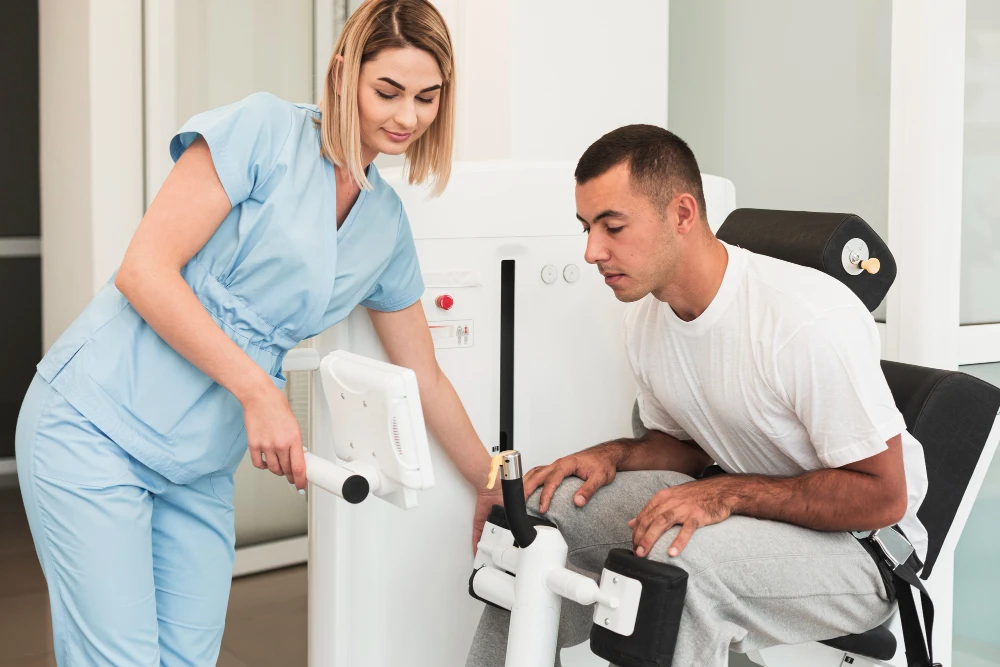

At Physiotherapy First, you get the best therapists from different disciplines, including Physiotherapy, chiropractic care, massage therapy, laser therapy, shockwave therapy and more.

We create a recovery roadmap, specifically for your procedure, whether it's ACL repair, spinal surgery or a total knee replacement surgery.

We are your trusted recovery partners. From motivating to guiding you with our clinical experience, we help you get back to your best self efficiently.
Address: 511 Ray Lawson Blvd. Unit 4 & 5 Brampton ON L6Y 0N2
Phone: 905-796-6662
Fax: 905-796-6662
Email: info@physiotherapyfirst.ca
Hear from 500+ Patients Who Found Relief